In September 2016, represented by the Great North Innocence Project and pro bono attorney David Schultz (Maslon LLP), Terry Olson was released from prison after serving almost 11 years for a crime he didn’t commit.

A Cold Case
In 1979, the body of Jeffrey Hammill was found in the early morning on the side of the road in rural Minnesota. He had one head wound. The Wright County Sheriff’s office investigated the case and interviewed dozens of people, but found no tire marks, no footprints, and no physical evidence as to what happened to Hammill.
One of the people interviewed in 1979 was Terry Olson. Hammill had been hitchhiking the night of his death, and Terry was in a car that picked him up and gave him a ride to the party at Terry’s sister’s home. Two other men – Dale Todd and Ron Michaels – were also in the car. Hammill continued walking after the car arrived at Terry’s sister’s house, and he died later that night.
All three men who had been in the car were questioned in 1979. Terry took two lie detector tests and passed them both.
After finishing the investigation, Wright County Sheriff’s Deputy James Powers concluded that Hammill’s death was likely the result of being hit by protruding farm equipment that was being transported in the middle of the night. The death was classified as “undetermined” and the case went cold.
New Sheriff Reopens the Case 24 Years Later
In 2003, a new sheriff in Wright County decided to reopen the case. He began by bringing in Dale Todd, the man who had been with Terry in the car that picked up Hamill as he was hitchhiking in 1979. Todd had a history of significant mental illness and had an addiction to painkillers.
Todd was questioned by agents from the Minnesota Bureau of Criminal Apprehension. He told the agents that he was not on his medication for his mental illness, and had a history of nervous breakdowns.
Todd told the agents for hours that he, Terry, and Michaels were not involved in Hammill’s death. The agents lied to Todd, insisting there was blood found on a bat in the trunk of the car the men had been riding in, and that they were going to test it. During the interrogation, Todd told the agents he was scared almost 50 times and said, “I’m thinking that I’m being trapped into something that I didn’t do.”
Hours into the interrogation Todd said, “I could just say what you want me to say – it was Terry and him. But I don’t think that’s justice.” Later, while crying, he finally told the agents that Michaels and Terry killed Hammill and he witnessed it.
Then, Todd was offered a deal by prosecutors – testify against Terry and Michaels and receive a lesser charge. He accepted it.
Recantations and the Trial
Both Terry and Michaels were charged with first degree murder based solely on the coerced statement of Todd.
Michaels’ trial was first. Todd testified, initially saying that Michaels had killed Hammill. But then Todd stated in court, “I didn’t do this. We didn’t do this. …What I am saying is that nobody wanted to believe me… They kept hounding me and hounding me. I can’t do this anymore… I can’t do it no more.”
When the prosecutor asked Todd why he initially said Michaels had killed Hammill, Todd said, “Because I didn’t want to go to jail for something I didn’t do.” The jury acquitted Michaels.
Then, because he recanted, prosecutors reneged the plea deal they had offered Todd and gave him a three-and-a-half-year prison sentence.
In 2007, despite Todd’s public recantation during Michaels’ trial, Terry was brought to court on first-degree murder charges, and Todd was brought in to testify against him.
Before the trial, Todd said he wanted to plead the fifth and not testify, but was told he could be held in contempt of court with added jail time. Sheriff Haggerty, as well as one of the agents who interrogated him, visited Todd’s jail cell the night before he was scheduled to testify. Todd later said he was afraid that if he didn’t testify, he would be charged with murdering Hammill.
Todd testified that Terry killed Hammill. Despite there being no physical evidence against Terry and Todd’s earlier public recantation, Terry was convicted in August 2007 and sentenced to 17 years in prison.
Three weeks later, Todd wrote a letter to the trial judge explaining he had lied at Terry’s trial, and stated he was “afraid to go to jail for life for something we did not do.” No hearing was held on Todd’s recantation.
Terry later said: “It’s hard to find a word that explains what I felt during that trial. It was scary. It was just terrifying. … I think it turned into a situation where someone had to be found guilty in this case. And I was the only one left.”
“People would expect me to hate Dale Todd. It made me cry… because at one point in my life he was my friend. And what they did to him was just as tragic as what they did to myself.”
“It’s hard to find a word that explains what I felt during that trial. It was scary. It was just terrifying. I think it turned into a situation where someone had to be found guilty in this case. And I was the only one left.”
— Terry Olson
Appeals & Freedom
Terry filed several appeals over the next decade and lost all of them. In 2011, he was offered a deal for assault with time served, and rejected it because he is innocent.
The Great North Innocence Project began investigating his case in 2012 and partnered with pro bono attorney David Schultz to represent him.
The same year, Todd contacted the Great North Innocence Project. For the first time in many years, his mental health issues were stabilized with medication. He stated that neither he nor Michaels or Terry Olson were involved in the death of Jeff Hammill and that police had frightened him into making a false confession. He provided a detailed affidavit explaining the circumstances of his false coerced confession.
In addition, at a hearing on Terry’s request for a new trial, Terry’s public defenders admitted that they provided him with poor representation in several key ways. One of the attorneys acknowledged that there were budget cuts and staffing problems in his office, that his caseload was unusually large, and he missed several important issues in Terry’s case.
Retired Wright County Sheriff’s Deputy James Powers also contacted the Great North Innocence Project to express his doubts that Hammill had been murdered by Terry, and reiterated that the death was likely accidental.
Terry’s legal team went to work litigating his case.
In one appeal in 2014, Terry’s legal team presented evidence that was not known at the time of the trial. This evidence showed that medical professions who were treating Todd during the time he was the prosecution’s star witness at Terry’s trial documented that Todd had suicidal thoughts, was hearing voices, had psychotic depression, and likely did not know right from wrong. The evidence also revealed that Todd told a doctor he would be testifying against an innocent man to get a “good deal” for himself.
One doctor recommended Todd be evaluated to determine if he was competent enough to testify. However, this evaluation was blocked by the chief deputy and district attorney.
Despite this new evidence, Terry’s appeal was denied.
GNIP and Schultz continued to collect evidence and, in 2015, filed a habeas petition in federal court, which included a claim of actual innocence.
Then, Terry’s legal team received a letter from Assistant Wright County Attorney Greg Kryzer, stating that the petition prompted his office to review Terry’s case. His office wanted to offer a deal: Terry would be released immediately, but Wright County would maintain that Terry was guilty of murder. Further, Terry would have to give up his right to appeal and his right to sue Wright County in the future. Or, Terry could wait for the appeal to be ruled on and go to trial, with Wright County having the ability to appeal any decision – a process that would likely take years.
Terry was worried about his mother. “Her health was bad at the time. And the one thing I did not want to happen in this was for my mother to pass away while her son was still in prison.”
Terry agonized over the deal. “That was a very confusing time for me,” he said. “Did I want out of prison? You bet I did. But I did not want out of prison that way. I had already spent 11 years in prison for something that I didn’t do. And I always felt that somehow the justice system would see through all this.”
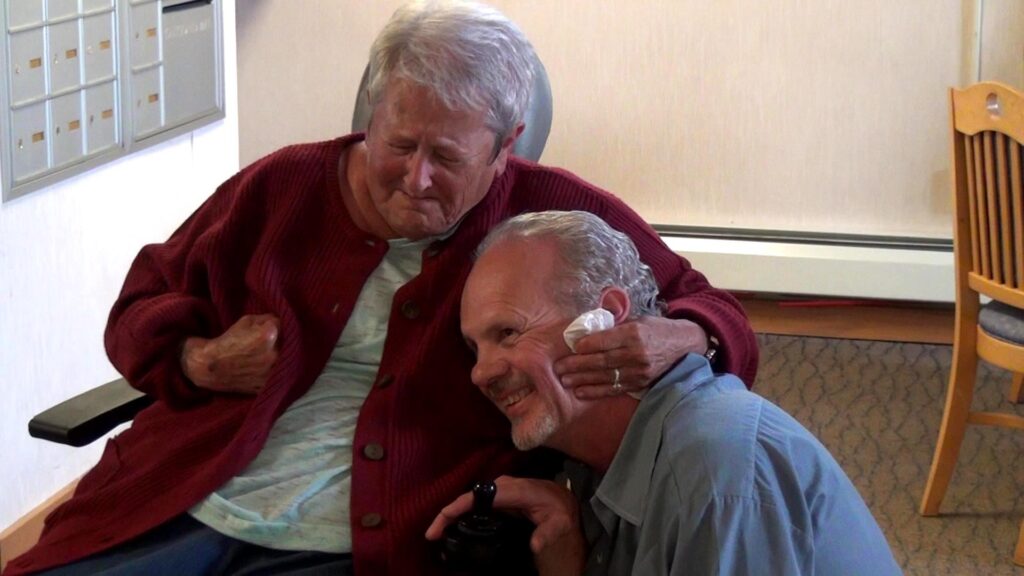
Terry decided to take the deal to reunite with his mother, and was released from prison in September 2016.
After being released Terry said, “I am super relieved. It’s been a long time coming.” After thanking his lawyers, he said, “I always had hope. They gave me that hope. That’s what brought me through this. Now I just want to go see my mom.”
His reunion with his mom and family was tearful and joyful. His mother said, “Nobody knows how glad I am.”

At a press conference with his lawyers, days after his release, Terry stated: “I realize that there are mistakes made in the judicial system, but it’s disappointing that it’s so excruciatingly hard to correct those mistakes.”
Terry had a message for other innocent people in prison: “Hold on. Hold on. Keep your faith.”
What’s Next
Terry now resides in Wisconsin with his beloved dog Tmoe. He continues working with the Great North Innocence Project and David Schultz to pursue a full exoneration and finally clear his name.
News Coverage
- ‘I was the only one left’: Despite chief witness recanting, Minnesota man still carries conviction for murder | KARE 11 | June 8, 2021
- Man who maintained innocence in 1979 cold-case death is freed | Bring Me the News | March 8, 2018
- Freed prisoner ready to begin new life | KARE 11 | September 17, 2016
- Man ‘wrongfully convicted’ in 1979 Homicide Released from Faribault Prison | CBS News | September 13, 2016