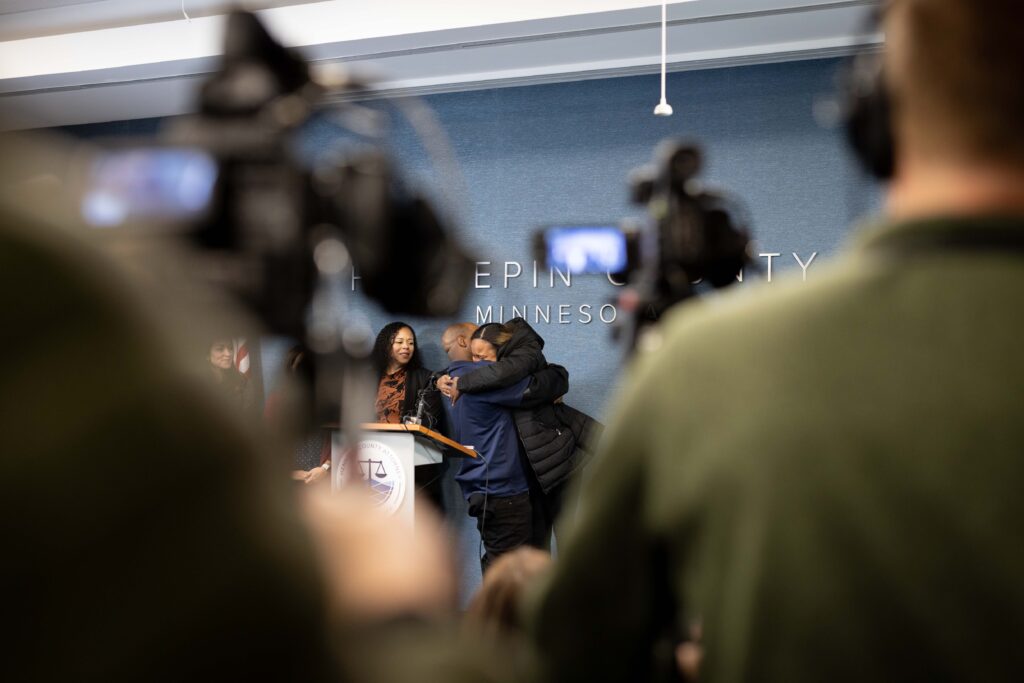
On December 11, 2023, Marvin Haynes was exonerated and released from the Minnesota Correctional Facility – Stillwater after spending nearly 20 years in prison for a crime he did not commit.
Robery turned homicide
Marvin was just 17 years old when he was convicted of first-degree murder in the shooting death of Harry “Randy” Sherer at a flower shop in North Minneapolis in May 2004. Mr. Sherer’s sister Cynthia McDermid was working at the flower shop when a man posing as a customer entered the store inquiring about a flower arrangement. Shortly thereafter, the individual drew a gun on Ms. McDermid and demanded that she give him the store’s money. Hearing the commotion, Mr. Sherer walked into the front of the store while Ms. McDermid ran for help. As she exited the store, she heard shots ring out.
When police arrived on the scene, they found Mr. Sherer had been shot and killed. Throughout their investigation, police found no physical evidence pointing to the identity of the perpetrator.
In her statements to the police, Ms. McDermid described the shooter as a young Black male with “short, close-cropped hair.” Another witness, then 14-year-old Ravi Seeley, told police that he saw the shooter fleeing the scene. He too described the perpetrator as a young, Black male with short hair.
A thin case and a weak conviction
The day after the shooting, the police showed Ms. McDermid a photo lineup, and she identified someone as the shooter with 75 to 80 percent confidence. However, the person she identified was out of state at the time of the murder, casting immediate doubt on Ms. McDermid’s memory of the perpetrator’s appearance.
Two days later, the police received an anonymous tip that named Marvin Haynes as the shooter. This complicated the investigation, because Marvin did not match the description Ms. McDermid and Mr. Seeley originally gave to police: most notably, he had a long, natural hairstyle. Subsequently, investigators showed both eyewitnesses a photo lineup, this time including a photo of Marvin. However, the police used a two-year-old photo that showed Marvin with short-cropped hair that much more closely matched the witnesses’ description of the perpetrator. In other words, the police did not show the witnesses a photograph of Marvin that accurately conveyed his appearance at the time of the shooting.
While Ms. McDermid and Mr. Seeley identified Marvin in the photo and live lineups, both witnesses expressed doubts about their identifications to investigators.
Furthermore, officers repeatedly deviated from best practices for lineup procedures throughout the investigation. Among several other errors, investigating officers administered the lineups themselves in lieu of a “double-blind” protocol, substantially increasing the risk of suggesting the identity of the suspect to witnesses.
GNIP finds new evidence
After applying for our services, the GNIP team uncovered new evidence that proved Marvin was innocent. One of the two eyewitnesses, Mr. Seeley, recanted his trial testimony and stated that he never actually got a good look at the perpetrator’s face and thus was not confident in his identifications in 2004. Mr. Seeley explained that he felt pressure to make a definitive identification to ensure a dangerous person would not get away with murder.
Isiah Harper and Anthony Todd, two witnesses who testified against Marvin at trial, recanted their testimony, reporting that they made their original statements only after police told them they could face their own criminal charges if they did not cooperate. Both men were juveniles at the time of their police interrogations.
Seeking post-conviction relief
Marvin’s legal team included then-GNIP managing attorney Andrew Markquart, GNIP staff attorney Anna McGinn, pro bono attorney and GNIP Board member Jazz Hampton of TurnSignl, GNIP volunteer Sydney Dobbs, former University of Minnesota Innocence Clinic student Trish Palermo, and many other law students and interns. GNIP filed a Petition for Post-Conviction Relief in Hennepin County District Court in June 2023. The State agreed to formally waive procedural and statute of limitations defenses, and consented to an evidentiary hearing.
During the evidentiary hearing held in November 2023, GNIP’s legal team presented evidence that demonstrated Marvin’s innocence. Dr. Nancy Steblay, Professor Emeritus of Psychology at Augsburg University and one of the country’s leading experts in the areas of eyewitness memory, testified to a litany of ways in which the eyewitness procedures used by police in the investigation went against best practices and called into question the reliability of any identifications made by the witnesses. Dr. Steblay also pointed out the obvious incongruities between the eyewitnesses’ descriptions of the perpetrator and Marvin.
Retired Minneapolis Police Lieutenant Michael Keefe testified that, as an investigating officer on this case, he himself objected to some of these problematic lineup procedures, but was overruled. He testified that, of the thousands of felony investigations he had worked on during his career, Marvin’s conviction was the only one where he had doubts as to the convicted individual’s guilt.
Marvin took the stand to assert his innocence, echoing the statements he made during his interrogation at age 16. Four of Marvin’s sisters also testified that he was asleep at home shortly before the shooting, calling into question the state’s case and purported timeline.
Free after nearly two decades
Ultimately, the Court granted Marvin’s Petition for Post-Conviction Relief and found that his conviction relied on constitutionally defective eyewitness evidence, violating his due process rights.
“I am not trying to make up for the past. I am going to create my future.“
— Marvin Haynes
In an order signed by Hennepin County District Court Judge William H. Koch, the Court held “that absent introduction of the unconstitutional eyewitness identification evidence, it is doubtful there would have been sufficient evidence to sustain a conviction.” Judge Koch further emphasized that no physical evidence ever connected Marvin to the crime.
The State agreed that “the interests of justice would be served by dismissing with prejudice all charges.”
GNIP lawyers shared the news of his vacated conviction with Marvin over the phone on December 6, his birthday—the last birthday he spent behind bars for a crime he did not commit.
Marvin’s story is featured in the National Registry of Exonerations.
News Coverage
- I Am Innocent: The Marvin Haynes Story | Fox 9 | December 13, 2024
- Maggie Freleng with Marvin Haynes | Wrongful Conviction Podcast | September 16, 2024
- 20 years after his murder arrest, Marvin Haynes reflects on long journey to freedom | Fox 9 | May 19, 2024
- Proposed wrongful-conviction bill would lower bar for new evidence | MPR News | February 21, 2024
- Minneapolis Man is freed after serving 19 years on murder charge | New York Times | December 11, 2023
- Great North Innocence Project client exonerated after nearly 20 years in prison for wrongful conviction | Great North Innocence Project Press Release | December 11, 2023
- Marvin Haynes, sentenced to life in 2004 flower shop killing, seeks to overturn conviction | Star Tribune | November 28, 2023
- [Great North] Innocence Project seeks to exonerate Marvin Haynes of 2004 north Minneapolis flower shop killing | Star Tribune | March 4, 2023